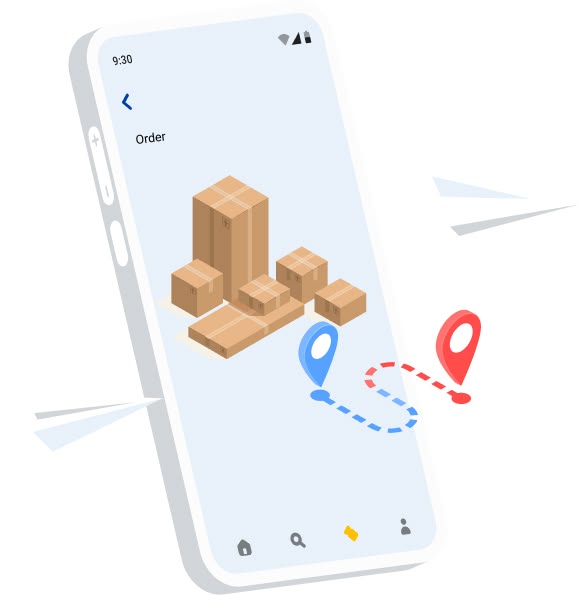
Plywood distribution runs on relationships and phone calls, a dealer calling to check if a size is in stock, a distributor calling back an hour later to confirm a delivery date, someone eventually writing the order down in a register. It works, but it doesn't scale cleanly, and it leaves both sides guessing more than they should. A custom mobile app for plywood dealers is built to close that gap, giving dealers a direct, real-time way to check stock, place orders, and track deliveries without a phone call in the middle.
For plywood distributors managing a network of dealers across a region, this isn't just a convenience upgrade. It changes how quickly orders get placed and how much manual coordination the distribution team has to do for each one.
Why Phone-Based Ordering Breaks Down as a Dealer Network Grows
A distributor with a handful of dealers can manage everything over calls and WhatsApp messages without much friction. Once the network grows past a certain size, the cracks start showing. Stock information given over a call is often outdated by the time the dealer calls, since nobody's checking the register in real time before answering.
Orders placed verbally sometimes get recorded incorrectly, wrong size, wrong quantity, wrong dealer account. And dealers calling repeatedly just to check on delivery status ties up staff time that could be spent on actual sales and relationship work.
None of this is a training problem. It's what happens when order-taking depends entirely on someone picking up a phone and manually cross-checking a paper or spreadsheet-based stock register in real time.
Common problems with phone-based ordering:
• Outdated stock information
• Incorrect product sizes or quantities
• Manual order entry and transcription errors
• Repeated delivery-status calls
• Higher support workload
• Limited visibility for dealers
What a Custom Plywood Dealer App Actually Does
Real-Time Stock Visibility by Size and Grade
Dealers can check current stock for specific plywood sizes, thicknesses, and grades directly in the app, pulling live data from the same inventory system the warehouse uses, rather than relying on whatever the person answering the phone last checked.
Direct Order Placement
Instead of calling in an order, dealers place it directly through the app, selecting products, quantities, and delivery preferences. This removes transcription errors that happen when someone verbally relays an order and another person writes it down.
Order and Delivery Tracking
Once an order is confirmed, dealers can track its status directly, dispatched, in transit, delivered, without needing to call and ask. For dealers managing their own downstream customers, this visibility lets them give accurate delivery estimates without waiting on a callback from the distributor.
Credit and Payment Visibility
Many plywood dealers operate on credit terms with their distributor. The app can show current outstanding balance, credit limit, and payment history, giving dealers clarity on their account status without needing to call accounts for a manual update.
Price List and Scheme Updates
Pricing and dealer schemes can be pushed to the app centrally, so every dealer sees current, accurate pricing at the same time, instead of working off an outdated printed price list or a rate that was quoted verbally weeks ago.
What Changes for the Distributor's Team
The most immediate shift is call volume. Dealer support staff spend far less time answering routine "is this in stock" or "where's my order" questions, since dealers can check both directly. That time gets redirected toward dealers who need actual sales attention, new product pushes, resolving genuine issues, or growing underperforming accounts.
Order accuracy also improves measurably, since orders are placed directly against live stock data rather than relayed through a phone call and re-entered by staff. Fewer wrong-size or wrong-quantity orders means fewer returns and fewer awkward conversations about who made the mistake.
Operational improvements can include:
• Fewer routine dealer calls
• Faster order processing
• Reduced manual data entry
• Fewer order-entry mistakes
• Better dealer visibility
• More time for sales and relationship management
Building for How Dealers Actually Work
A plywood dealer network often includes dealers with varying levels of comfort with technology, and the app needs to account for that rather than assuming universal smartphone fluency. Keeping the interface simple, showing stock and pricing clearly without unnecessary screens, and supporting regional language options where relevant, all matter more for adoption than adding advanced features few dealers will actually use.
A well-adopted simple app beats a feature-rich one that half the dealer network avoids because it's confusing.
Rolling It Out Without Losing Dealers Along the Way
Distributors that succeed with this kind of rollout usually start with a smaller group of tech-comfortable dealers first, work out any rough edges with real orders flowing through the app, and then expand to the full network with support staff on hand to help dealers who need it.
Trying to switch the entire network over on day one, without that runway, tends to push hesitant dealers straight back to the phone.
A practical rollout can look like:
• Start with a small group of dealers
• Process real orders through the app
• Collect dealer feedback
• Fix usability and workflow issues
• Train support staff
• Expand gradually across the network
Connecting the App to the Rest of the Distribution Business
A dealer app that stands alone as a separate system, disconnected from the actual inventory, accounts, and dispatch data, ends up creating a second source of truth that constantly falls out of sync with reality.
The stronger approach connects the app directly to the same ERP backend the warehouse and accounts team already use, so an order placed by a dealer instantly reflects in stock allocation, and a payment recorded by accounts instantly updates what the dealer sees as their outstanding balance.
This matters most during the busy season, when order volume spikes and any manual reconciliation between a standalone app and the actual warehouse system becomes a serious operational risk.
If the app is just showing a cached or periodically synced version of stock rather than live data, dealers start placing orders for sizes that are actually already sold out, which creates exactly the kind of frustration the app was meant to prevent in the first place.
What This Looks Like for a Mid-Size Plywood Distributor
Picture a distributor running twelve to fifteen dealers across two districts, currently managing everything through a shared phone line and a support staff member who spends most of the day fielding stock and order status calls.
After rolling out a dealer app connected to live inventory, that support role shifts from constantly answering routine questions to actively following up with dealers who haven't ordered in a while, or helping onboard new dealer accounts, work that actually grows the business rather than just keeping it running.
Order processing time typically drops as well, since orders arrive already structured and correctly formatted rather than needing to be interpreted from a phone call and manually entered. For a distributor processing dozens of orders daily, that time saved on data entry alone can contribute significantly to the business case for the app.
Instead of spending the day on:
• Stock availability calls
• Delivery status calls
• Manual order entry
• Payment balance queries
• Rechecking dealer information
The team can spend more time on:
• Dealer relationship building
• New dealer onboarding
• Sales follow-ups
• Product promotion
• Underperforming account development
Deciding Between a Custom App and an Off-the-Shelf Ordering Tool
Generic order-taking apps exist, but plywood distribution has enough industry-specific quirks, sizing and grading conventions, credit-based dealer relationships, regional pricing schemes, that a one-size-fits-all tool usually ends up needing workarounds that frustrate both dealers and staff.
A custom build costs more upfront than a generic subscription tool, but it's built around how your specific dealer network actually operates rather than forcing your business to adapt to a generic workflow that wasn't designed with plywood distribution in mind.
The more practical question for most distributors isn't custom versus generic in the abstract, but whether an off-the-shelf tool can actually represent your specific grading system, credit terms, and dealer hierarchy without constant manual workarounds.
If the answer is no, particularly for distributors with meaningful complexity in pricing or credit structure, a custom build can provide a more direct way to match the software to the existing distribution workflow, even with a higher initial cost.
Before choosing a solution, evaluate whether it can handle:
• Plywood sizing and grading conventions
• Dealer-specific pricing
• Credit limits and payment terms
• Dealer hierarchies and territories
• Product-specific schemes
• Live inventory availability
• Dispatch and delivery workflows
• ERP integration
The Practical Business Case for a Plywood Dealer App
A dealer app isn't simply about giving distributors a more modern ordering interface. The real operational value comes from removing repetitive coordination from the distribution process while giving dealers faster access to information they already need.
When stock availability, ordering, delivery tracking, pricing, credit information, and payments are connected to the distributor's existing systems, the app becomes part of the distribution workflow rather than another tool that staff have to maintain separately.
Ready to Build a Custom Plywood Dealer App?
Let us review your current dealer ordering process, inventory workflows, ERP setup, pricing structure, credit terms, dispatch operations, and recurring support bottlenecks.
We'll identify the right features for your dealer network, from real-time stock visibility and direct order placement to delivery tracking, payment visibility, dealer pricing, and ERP integration.
Book a free consultation and get a practical view of how a custom dealer app can reduce manual coordination and make ordering easier for both your dealers and your distribution team.
Book Free Consultation