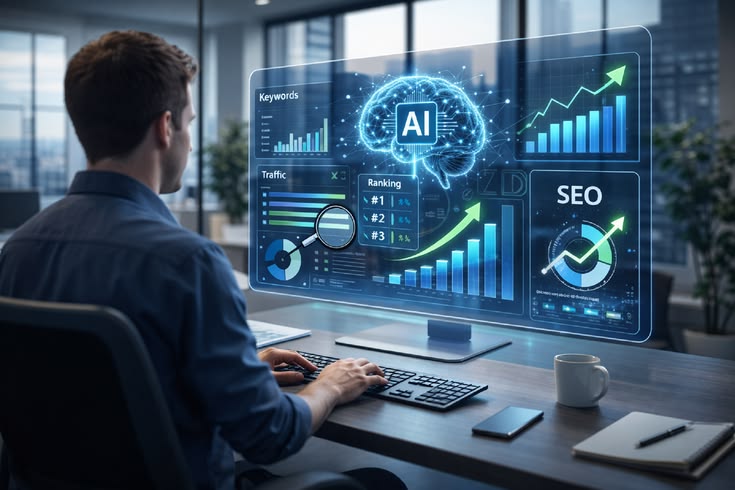
Building AI-Powered Dashboards for Business Intelligence
Most business dashboards are just pretty charts of old data. You look at last month's sales, last week's production output, or yesterday's dispatch numbers.
By the time you see a problem in a standard dashboard, it has usually been a problem for days.
AI-powered dashboards for business intelligence work differently. They do not just show you what happened — they tell you what is likely to happen, flag anomalies the moment they appear, and surface insights you would never think to look for.
For business owners managing sales, operations, accounts, inventory, and supply chains, this is the difference between running a business reactively and managing it proactively.
At Sunray Datalinks, we build custom AI dashboards using Odoo data, ERP systems, and external business data sources to help organisations make faster and smarter decisions.
What Makes a Dashboard AI-Powered?
The term AI is used frequently, but in business intelligence it has a very specific meaning.
A traditional dashboard collects data from a database and presents it through charts, tables, and KPIs.
It only displays the metrics you have configured. The intelligence comes from the person interpreting the dashboard.
An AI-powered dashboard goes beyond reporting. It uses machine learning models to discover patterns, forecast future outcomes, detect unusual behaviour, and generate recommendations automatically.
Instead of simply showing historical performance, it helps predict future performance and highlights areas that require attention.
For example, the dashboard may predict inventory shortages, identify customers at risk of churn, or highlight operational inefficiencies before they become serious problems.
What AI Dashboards Can Actually Do
Machine learning enables dashboards to uncover insights that are difficult or impossible to identify manually.
- Predict future sales and demand trends
- Detect unusual financial or operational activity
- Identify customer buying patterns
- Forecast stock requirements
- Recommend actions based on historical outcomes
- Provide real-time alerts for emerging risks
This allows managers to spend less time analysing reports and more time making informed business decisions.
Key Modules in an AI-Powered Business Intelligence Dashboard
1. Sales Intelligence
AI-powered sales dashboards go far beyond revenue reporting.
They analyse customer behaviour, identify buying trends, predict lead conversion probability, and highlight cross-sell and upsell opportunities.
The system can also detect early signs of customer churn, allowing sales teams to take action before valuable accounts are lost.
2. Inventory and Supply Chain Analytics
Inventory forecasting is one of the strongest applications of AI in business intelligence.
Machine learning models analyse historical demand, seasonal fluctuations, supplier lead times, and stock movement patterns to recommend optimal inventory levels.
This helps businesses reduce excess inventory while minimising stock shortages that can impact customer satisfaction.
3. Financial Intelligence
AI-driven financial dashboards continuously monitor business transactions and financial performance.
They can detect unusual expense patterns, predict cash flow gaps, identify revenue risks, and flag anomalies that deserve further investigation.
For business owners and finance teams, this creates an always-active monitoring layer that never overlooks critical trends.
4. Production and Operations Monitoring
For manufacturing organisations, AI dashboards can analyse production data to identify operational bottlenecks and predict maintenance requirements.
The system can detect quality issues early, optimise production scheduling, and improve resource allocation across operations.
This shifts businesses from reactive problem-solving to predictive operational management.
How We Build AI Dashboards at Sunray Datalinks
Every successful AI dashboard starts with quality data.
Before building models, we assess existing business systems including Odoo, ERP platforms, accounting software, CRM applications, production systems, and external data sources.
We evaluate data quality, completeness, consistency, and historical depth to ensure the models have reliable information to learn from.
Once the data foundation is established, we build machine learning models tailored to specific business requirements.
- Time-series forecasting for sales and inventory prediction
- Customer segmentation through clustering techniques
- Anomaly detection for financial and operational monitoring
- Predictive analytics for business planning and forecasting
Our focus is not on experimental AI projects. We apply proven machine learning methods that deliver measurable business value.
The dashboard interface is then designed for business users, ensuring that managers can easily understand insights and take action without requiring technical expertise.
We also implement continuous feedback loops so that model accuracy improves as more business decisions and outcomes are recorded over time.
Which Businesses Benefit Most from AI Dashboards?
AI-powered dashboards generate the greatest value when businesses have sufficient historical data and operational complexity.
Typically, organisations see the strongest results when they have been operating for multiple years, generate significant transaction volumes, and manage a variety of products, customers, locations, or business processes.
- Manufacturers managing multiple production lines and product categories.
- Distributors and wholesalers handling large SKU inventories and diverse customer bases.
- B2B service providers maintaining recurring customer relationships.
- Retail businesses operating across multiple sales channels and locations.
The more data your business generates, the more opportunities AI has to uncover valuable insights.
Why Odoo Is an Excellent Foundation for AI Dashboards
If your organisation already uses Odoo as its ERP platform, you have a strong foundation for advanced business intelligence.
Odoo stores structured data across sales, inventory, accounting, manufacturing, CRM, and operations, making it ideal for machine learning applications.
Because the data is already centralised, AI models can be deployed more quickly and with greater accuracy compared to fragmented systems.
We have built AI dashboards on top of Odoo for multiple clients, helping them convert operational data into meaningful business intelligence.
Working with Sunray Datalinks
At Sunray Datalinks, we help businesses transform ERP and operational data into actionable intelligence through custom AI-powered dashboards.
Our team manages the entire process, including data assessment, integration, dashboard development, machine learning implementation, testing, and user training.
Whether you want better forecasting, smarter inventory management, stronger financial visibility, or predictive operational monitoring, we build solutions designed around your business goals.
The Bottom Line
Traditional dashboards tell you what has already happened.
AI-powered dashboards help you understand what is happening now, what is likely to happen next, and what actions you should consider taking.
By combining machine learning, business intelligence, and ERP data, organisations gain deeper visibility, faster decision-making, and a stronger competitive advantage.
For businesses looking to move beyond reporting and into predictive decision-making, AI-powered dashboards provide a practical and highly valuable next step.
Ready to Turn Your Business Data into Actionable Intelligence?
AI-powered dashboards can help you forecast demand, identify risks, optimise operations, and make faster decisions with confidence.
Our experts can evaluate your existing systems, identify the right AI opportunities, and build a roadmap tailored to your business goals.
Let's discuss how AI-powered business intelligence can improve visibility, efficiency, and growth across your organisation.
Book Free Consultation