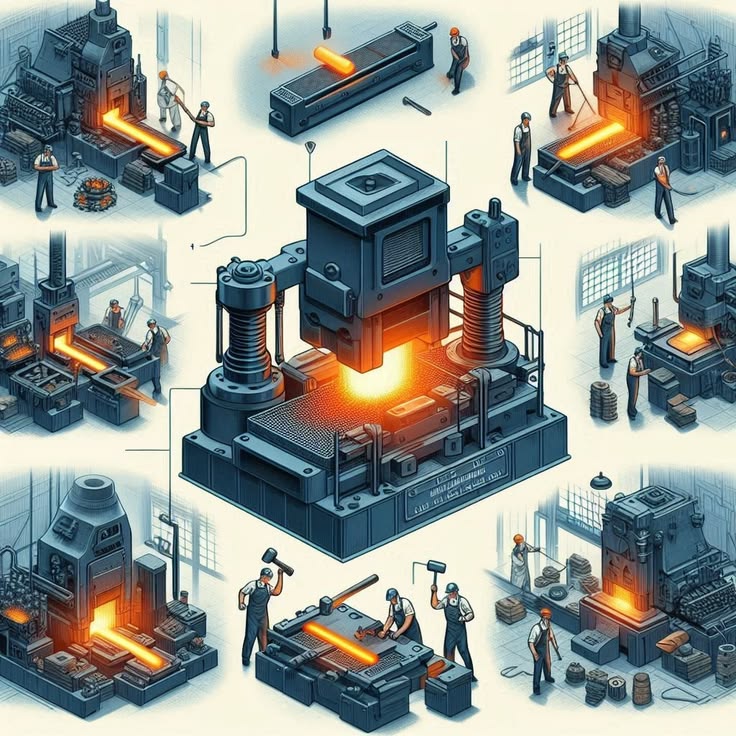
Case Study: Forging Unit Reduces QC Rejection Rate by 35% Using Odoo Quality Control
For forging manufacturers, product quality determines customer trust, production efficiency, and long-term profitability. However, many forging units continue to rely on paper-based quality records, making it difficult to identify the root causes of defects or defend themselves when customers raise quality concerns.
This case study explores how a Rajkot-based closed-die forging manufacturer transformed its quality management process by implementing a custom Odoo ERP with digital job cards, heat lot tracking, in-process quality control, and die life management.
Within six months of implementation, the company reduced its overall rejection rate by 35%, dramatically improved traceability, strengthened customer confidence, and gained complete visibility into every stage of production.
At a Glance
- Industry: Closed-Die Forging (Automotive & Industrial Components)
- Location: Rajkot, Gujarat
- Production Volume: 40–60 tonnes per month across 200+ SKUs
- Challenge: High rejection rates with limited production traceability
- Solution: Odoo ERP with Digital Job Cards, Heat Tracking, In-Process QC, and Die Life Management
- Implementation Timeline: 12 Weeks
- Key Result: 35% reduction in overall QC rejection rate
Client Overview
The client is an established closed-die forging manufacturer based in Rajkot, supplying precision automotive and industrial components to Tier-1 and Tier-2 customers across Gujarat and Maharashtra.
Having operated successfully for nearly two decades, the company had developed strong manufacturing expertise and maintained long-term relationships with several leading industrial customers.
Despite their technical capabilities, increasing production volumes and growing customer quality expectations exposed weaknesses in their paper-based quality management process.
While the production team consistently manufactured quality components, the lack of digital traceability made it difficult to investigate defects, identify recurring quality issues, or provide evidence whenever customers questioned product quality.
The Challenge: High Rejection Rates Without Root Cause Visibility
After reviewing the client's manufacturing and quality processes, Sunray Datalinks identified several operational gaps that prevented the company from reducing rejection rates despite its experienced workforce.
Limited Production Traceability
When rejected components were identified during final inspection or by customers, there was no efficient method to trace them back to the specific heat lot, operator, machine, or production batch responsible for manufacturing the parts.
Paper-Based Job Cards
Production information was recorded manually on paper job cards that were often incomplete, difficult to retrieve, or unavailable when quality investigations were required.
Quality Checks Happened Too Late
Quality inspections were primarily performed at the final inspection stage, allowing defects generated during forging or trimming to remain undetected until significant production had already been completed.
No Visibility into Die Performance
Forging dies continued operating until visible failures occurred because die life was not monitored systematically. Gradual dimensional wear frequently resulted in increasing rejection rates before maintenance was scheduled.
Customer Rejections Were Difficult to Defend
Whenever customers reported dimensional or quality issues, the company lacked reliable production records to determine whether the problem originated during manufacturing or after dispatch.
As a result, customer claims were often accepted without sufficient evidence, increasing both replacement costs and quality-related losses.
The Solution Sunray Built
To eliminate manual quality tracking and provide complete production traceability, Sunray Datalinks implemented a forging-specific Odoo ERP solution covering production, inventory, quality control, and maintenance.
The implementation was designed around the company's actual shop-floor workflow rather than forcing production teams to adapt to generic ERP processes. Every stage—from furnace charging to final dispatch—was digitally connected inside a single system.
Phase 1: Digital Job Cards with Operator & Machine Tracking
Every production order automatically generated digital work orders for each manufacturing stage, including furnace, forging press, trimming, shot blasting, and final inspection.
Operators completed their assigned work orders directly from shared shop-floor terminals by recording their employee ID, machine used, production start and finish times, output quantity, and rejection count.
Each work order had to be completed before production could proceed to the next stage, eliminating missing paperwork and ensuring accurate production records for every batch.
The result was complete digital traceability without relying on handwritten job cards or end-of-shift data entry.
Phase 2: Heat Lot Tracking from Furnace to Dispatch
Every furnace charge was registered as a unique heat lot before production began. Material grade, furnace identification, target temperature, and soaking duration were recorded automatically inside Odoo ERP.
As forged components moved through production, they remained linked to their original heat lot, creating complete traceability throughout the manufacturing process.
The heat lot number was also included on dispatch documentation, allowing the company to trace any customer complaint back to the exact furnace batch within minutes.
Instead of searching through paper registers, quality engineers could instantly review furnace parameters, production records, and customer deliveries associated with a specific heat lot.
Phase 3: In-Process Quality Control
Rather than inspecting components only after production was complete, quality checkpoints were introduced throughout the manufacturing process.
Inspection stages were configured immediately after forging, after trimming, and during final inspection to verify dimensions, weight, visual quality, hardness, and customer-specific specifications.
Quality inspectors recorded measurement values directly inside Odoo along with their employee identification and inspection results.
Production could not continue until the required quality checks had been successfully completed, allowing defects to be identified before additional processing increased manufacturing costs.
Phase 4: Die Life Monitoring & Preventive Maintenance
Every active forging die was registered inside Odoo with its recommended production life based on the expected number of forging shots.
As production orders were completed, the ERP automatically updated die usage counts and monitored remaining service life.
Once a die approached approximately 85% of its expected operating life, the system automatically generated a maintenance alert so refurbishment could be scheduled before dimensional wear affected product quality.
This preventive approach eliminated the previous practice of operating dies until visible failure occurred, significantly reducing dimensional variation across production batches.
Implementation: From Planning to Go-Live in 12 Weeks
The implementation followed a phased approach to minimize production disruption while allowing operators, supervisors, and quality inspectors to gradually adopt the new digital workflow.
Rather than replacing every process at once, the project introduced digital production management step by step, ensuring each department became comfortable before moving to the next phase.
Weeks 1–3: Process Mapping & ERP Configuration
The project began with detailed process mapping of production routing, material masters, product structures, and the company's highest-volume SKUs. Standard operating procedures were configured inside Odoo to reflect the actual forging workflow.
Weeks 4–7: Digital Job Card Rollout
Digital job cards were introduced at the forging press and trimming stations. Furnace heat lot registration was integrated into the production process, enabling complete batch traceability from the very beginning of manufacturing.
Weeks 8–9: Quality Control Configuration
Quality checkpoints were configured for each production stage, and inspectors received practical training on recording measurements, inspection results, and non-conformance data directly inside Odoo ERP.
Weeks 10–12: Die Tracking & Full Deployment
Die life monitoring, maintenance scheduling, and complete production workflows were activated across the shop floor. During the final weeks, Sunray Datalinks closely monitored user adoption and optimized the system based on operator feedback.
Encouraging Shop-Floor Adoption
The primary challenge was introducing digital recording into a fast-moving forging environment. Operators were accustomed to working without entering production data between manufacturing stages.
To simplify adoption, Sunray implemented a barcode-based interface that allowed operators to scan the heat lot, identify themselves, record production quantities, and complete each transaction in less than one minute.
The Results After Six Months
Six months after implementation, the forging unit had transformed quality management from a paper-driven process into a fully digital manufacturing workflow supported by complete production traceability.
Instead of reacting to customer complaints after products had already been dispatched, the company could identify quality trends during production, investigate issues quickly, and continuously improve manufacturing performance using reliable operational data.
Quality Improvements
- 35% reduction in overall quality rejection rate
- Average rejection reduced from 8.2% to 5.3%
- Several high-rejection SKUs reduced from over 10% to below 3%
- Greater consistency across production batches
Production Improvements
- 100% digital job card adoption achieved within eight weeks
- Complete traceability from raw material to dispatch
- Real-time production visibility for supervisors
- Preventive die maintenance reduced dimensional variation
Customer Quality Improvements
- Customer rejection investigations reduced from 48 hours to under 2 hours
- Two major rejection claims successfully resolved using digital production evidence
- Higher customer confidence through complete production traceability
- Major automotive customer restored the supplier's normal approval status after quality audit
Operational Productivity Improvements
- Quality investigations completed in minutes instead of days
- Production teams identified recurring rejection patterns much earlier
- Management gained real-time quality reporting across all production orders
- Manual paperwork was virtually eliminated from shop-floor operations
What Made the Difference
In-Process Quality Control Instead of Final Inspection
One of the biggest improvements came from shifting quality control earlier in the manufacturing process. By introducing inspection checkpoints after forging and trimming, defects were identified before additional processing increased production costs.
Instead of discovering problems only during final inspection, production teams could immediately correct process deviations and prevent large batches of defective components.
Die Life Tracking Revealed Hidden Quality Problems
The new die management system revealed that several high-rejection products were consistently being manufactured using dies that had exceeded their recommended service life.
After preventive refurbishment was introduced, rejection rates for these products fell dramatically within only a few production cycles.
Production Data Became Actionable
Rather than recording only the total number of rejected parts, Odoo captured rejection reasons, production stage, operator information, machine details, and heat lot data for every non-conformance.
This transformed rejection reports into practical improvement tools, enabling engineers to identify recurring quality trends and implement targeted corrective actions.
Key Lessons from the Project
Quality Problems Are Often Data Problems
Many manufacturers already possess the technical expertise needed to produce quality components. However, without accurate production data, identifying the true causes of defects becomes extremely difficult.
Traceability Builds Customer Confidence
Complete traceability from raw material through production and dispatch allows manufacturers to investigate customer complaints quickly while demonstrating compliance with customer quality requirements.
Preventive Maintenance Improves Product Quality
Monitoring die life inside the ERP prevented gradual dimensional variation that previously went unnoticed until rejection rates increased significantly.
Integrated ERP Delivers Greater Operational Value
By connecting production, quality, inventory, and maintenance inside a single ERP platform, the company eliminated duplicate records, accelerated investigations, and improved decision-making across departments.
What This Means for Growing Forging Manufacturers
As production volumes increase, paper-based quality management becomes increasingly difficult to maintain. Missing records, delayed investigations, and limited production visibility make it harder to improve quality or satisfy demanding customer audits.
A forging-specific Odoo ERP with digital job cards, heat lot tracking, in-process quality control, and die life management provides manufacturers with complete production visibility while supporting continuous quality improvement.
Instead of reacting to quality issues after production is complete, manufacturers gain the ability to identify, prevent, and resolve problems throughout the production process.
Sunray Datalinks: Odoo ERP for Forging Manufacturers
Sunray Datalinks develops industry-specific Odoo ERP solutions for forging manufacturers across India. Our systems are designed around real shop-floor operations, helping manufacturers improve quality, increase traceability, and streamline production management.
From digital job cards and heat lot tracking to in-process quality control, die life management, production planning, inventory, and maintenance, we deliver integrated ERP solutions tailored to the operational requirements of modern forging companies.
Our goal is to help manufacturers build data-driven production systems that reduce rejection rates, strengthen customer confidence, and support sustainable business growth.
Ready to Reduce Rejection Rates with Odoo ERP?
Discover how a forging-specific Odoo ERP solution can improve product quality, strengthen production traceability, and reduce costly manufacturing defects.
Sunray Datalinks helps forging manufacturers implement digital job cards, heat lot tracking, in-process quality control, die life management, and complete production automation using Odoo ERP.
Schedule a consultation to learn how a customized ERP solution can transform your manufacturing operations and support long-term growth.
Book Free Consultation