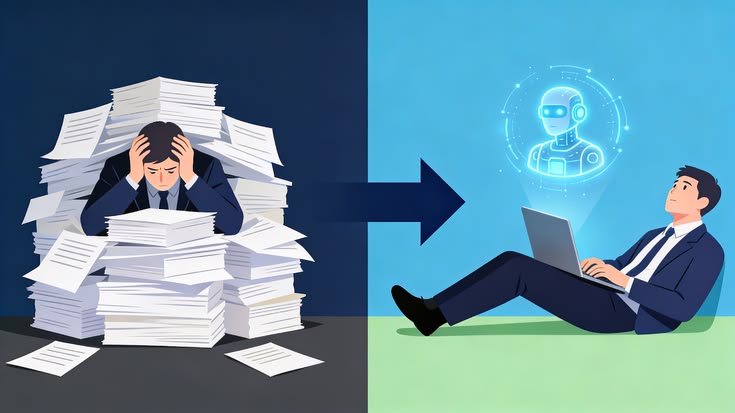
How AI Is Disrupting Traditional ERP Software
AI is disrupting ERP software in a way that has not happened since the cloud shift a decade ago.
The traditional ERP playbook — capture every transaction, generate every report, and trust the human to act on it — is being rewritten in front of us.
The next generation of ERP does not just record what happened. It decides, recommends, and increasingly acts on its own.
For business owners who have spent crores on legacy systems, this is both a threat and an opportunity worth understanding.
What Businesses Are Experiencing Right Now
At Sunray Datalinks, we build and implement ERP systems for manufacturers, transport companies, retailers, and service businesses.
Over the last eighteen months, nearly every serious ERP conversation has shifted from:
"What modules do we need?"
to:
"What can the system do on its own?"
This article explains what is actually changing, what is hype, and what your business should realistically do next.
The Old ERP Model Was Built for a Slower World
Traditional ERP systems were designed in an era when monthly reports were enough.
A team entered orders, posted invoices, generated reports, and made decisions during weekly meetings.
That model worked when supply chains moved slowly and competition was mostly local.
It does not work in 2026, where customer expectations, raw material prices, supplier behaviour, and market conditions change every few hours.
The old ERP model told you what happened last week.
AI-powered enterprise software tells you what is about to happen and increasingly fixes issues before your team even notices them.
Where AI Is Already Replacing ERP Workflows
Forget the abstract AI debates.
Here is where businesses are already seeing measurable results.
1. Forecasting and Demand Planning
Demand planning has traditionally been one of ERP's weakest areas.
Most companies still rely on assumptions, moving averages, or sales-team estimates.
AI forecasting models analyse historical sales, seasonality, market trends, and regional behaviour to generate far more accurate predictions.
For manufacturers, distributors, and trading businesses, this alone can reduce inventory costs by ten to twenty percent.
2. Document and Data Entry Automation
Vendor invoices, purchase orders, delivery challans, and GRNs still consume countless manual hours.
AI document processing can read PDFs, scanned documents, and even WhatsApp images, extract structured data, and automatically post entries into the ERP.
Finance teams that once needed multiple people for invoice processing can now operate with significantly smaller teams.
3. Customer Service and Order Status
Most businesses receive the same repetitive customer queries every day.
Where is my order?
Is this item in stock?
What is the latest price?
AI customer-service agents connected to the ERP can answer these instantly through WhatsApp, websites, or email without involving a human employee.
The result is faster customer responses and sales teams that can focus on actual selling instead of repetitive support tasks.
4. Anomaly Detection in Accounting
AI is extremely effective at identifying unusual financial behaviour.
Duplicate vendors, suspicious ledger entries, unexpected margin drops, or irregular expense patterns can all be flagged automatically.
Internal audits that once happened yearly can now happen continuously in the background.
5. Smarter Procurement Decisions
Traditional ERP reorder logic is rigid.
When stock reaches a fixed threshold, the ERP generates a purchase order.
AI-based procurement systems consider supplier reliability, demand trends, delivery lead times, and price fluctuations before recommending what to purchase and when.
Procurement heads still approve the purchase, but the recommendation is now data-driven instead of rule-based.
From Reactive ERP to Agentic ERP
The larger shift happening now is the move from ERP as a record-keeping system to ERP as an operational actor.
Agentic AI systems sit on top of ERP platforms and execute workflows from start to finish.
For example, an AI-powered accounts payable workflow can:
- Receive vendor invoices automatically
- Validate them against purchase orders and GRNs
- Check vendor history and pricing patterns
- Raise exceptions when something looks wrong
- Post accounting entries after reconciliation
All of this can happen without a person manually typing anything.
This is where ERP is heading next — not flashy AI chatbots, but invisible background agents quietly handling operational work.
What This Means for Your Existing ERP
If your business already uses a modern ERP platform like Odoo, the good news is that AI does not require a complete rebuild.
AI agents can sit on top of your current system because your workflows and structured data already exist.
However, businesses still running heavily customised legacy ERP systems face a different challenge.
Older platforms were not designed for APIs, automation, or AI integrations.
In many cases, modernising the ERP platform first is more practical than trying to force AI into outdated infrastructure.
For many mid-sized businesses, migrating to a modern ERP platform and then layering AI capabilities gradually is the most sustainable approach.
What AI Hype You Should Ignore
Not everything branded as AI creates business value.
Many vendors simply repackage old dashboards and reports with AI labels.
An AI system that only summarises last quarter's sales data is not transformation — it is reporting with new branding.
A better question to ask vendors is:
"What operational decision does this AI actually improve?"
If the answer is unclear, the AI likely has little practical value.
Businesses should also pay attention to data privacy and hosting.
For Indian companies handling financial data or customer information, local hosting and private-cloud deployments are becoming increasingly important.
A Practical AI ERP Roadmap for the Next Twelve Months
For businesses wondering where to begin, the smartest approach is usually gradual adoption.
- First, clean and standardise your ERP data
- Second, identify one workflow with measurable ROI
- Third, pilot the workflow for ninety days
- Finally, expand only after proving results
The best first AI use cases are usually:
- Invoice processing
- Customer support automation
- Demand forecasting
- Procurement optimisation
Trying to automate the entire organisation at once often leads to failed projects and wasted budgets.
The businesses seeing success today are stacking small, working AI agents on top of reliable ERP foundations.
Where Sunray Fits In
At Sunray Datalinks, we help businesses cut through the AI noise and focus on practical business outcomes.
Our team builds custom AI agents on Odoo and other ERP platforms, integrates them with WhatsApp, email, and operational workflows, and deploys them in real production environments.
Whether you want to automate finance workflows, improve forecasting, or reduce operational overhead, we help you identify the quickest and safest starting point.
The Bottom Line
AI is not replacing ERP systems.
It is transforming what ERP systems are expected to do.
The future ERP platform is not just a database of transactions.
It is an intelligent operational layer that predicts problems, automates repetitive work, and supports better business decisions in real time.
The businesses that adapt early will gain efficiency, speed, and competitive advantages that slower companies will struggle to match.
Want to Explore AI for Your ERP?
Not every business needs full-scale AI transformation from day one.
The key is identifying the workflows where automation creates measurable business value quickly.
Talk to our team and we will help you evaluate your ERP setup, identify high-impact AI opportunities, and build a practical roadmap for implementation.
Book Free Consultation