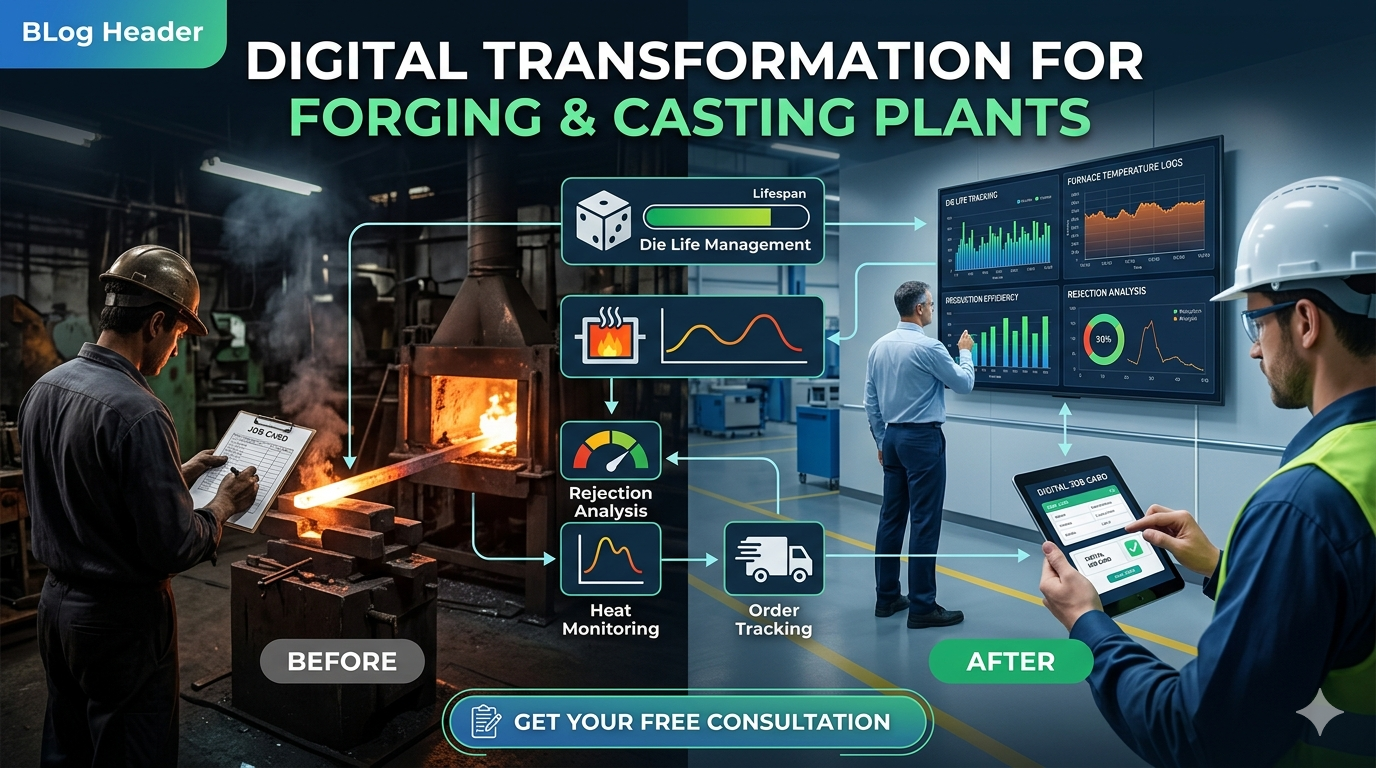
What Makes Forging & Casting Unique — and Why Generic Software Fails
Forging and casting are process-heavy industries with very specific operational requirements that most off-the-shelf ERP software does not understand.
A forging plant needs to track die life, hammer utilisation, heat numbers, and per-piece rejection rates. A casting unit deals with pattern management, mould cycles, furnace temperature logs, and alloy composition records.
A generic manufacturing ERP built for discrete production cannot handle this without significant customisation.
Key Areas of Digital Transformation for Forging & Casting
1. Digital Job Cards and Work Order Management
Paper job cards are one of the biggest sources of data loss. By the time data reaches the office, it is delayed or incomplete.
Digital job cards allow operators to update production in real time from the shop floor, ensuring every batch and operation is recorded instantly.
2. Die and Tooling Life Tracking
In forging, die life directly impacts cost and quality. Manual tracking often leads to early replacement or late failure.
A digital system tracks strike counts, maintenance history, and remaining life for each tool.
3. Furnace and Heat Monitoring Integration
Temperature variations directly affect casting quality, but manual logging misses real fluctuations.
IoT-enabled systems continuously capture furnace data and flag deviations instantly.
4. Inventory and Raw Material Tracking
Raw material management involves varying quality, cost, and supplier lead times, often leading to excess inventory.
A digital inventory system tracks batch consumption, predicts shortages, and automates procurement.
5. Quality and Rejection Analysis
Knowing total rejection rate is not enough — you need insights by machine, shift, operator, and material.
A connected quality module enables deep analysis without manual tracking.
6. Customer Order Tracking and Dispatch Management
Customers expect accurate delivery timelines and visibility into order status.
A connected system enables real-time tracking and automated dispatch workflows.
The Business Case: What Changes After Digital Transformation
- 20–35% reduction in rejection rates
- 15–25% improvement in on-time delivery
- Lower raw material inventory through accurate tracking
- Faster financial closing with real-time data
- Improved customer retention and satisfaction
Where to Start
Start with high-impact areas like production tracking and quality management. Once stabilized, expand to other processes.
Success depends on choosing a partner who understands forging and casting workflows — not just ERP software.
Take the First Step
Get a free consultation to identify high-impact opportunities and build a clear digital roadmap for your plant.
Get a Free Consultation